
Speed limits in Ireland
- What you need to know about speed limits in Ireland
- 2025 speed limit changes
- Types of speed limits
- Speed enforcement in Ireland
- Fines and penalties for speeding
- More information
What you need to know about speed limits in Ireland
There are different types of speed limits which apply to different types of roads throughout the country. Speed limits are set by national legislation.
Local authorities can also set speed limits locally. There are speed limits for certain types of vehicles as well.
What do speed limits look like?
All speed limits are shown in kilometres per hour (km/h).
They are marked by clear road signs. These circular signs generally have a white background, red border, and show the speed in black numbers.
You can read more in the guidelines for setting and managing speed limits in Ireland chapter 4 and chapter 7 (pdf).
2025 speed limit changes
From 2025, many speed limits in Ireland will be lowered.
In short, the speed limits have been or will be reduced:
- In rural areas to 60km/h
- On many roads in urban areas to 30km/h
- On national secondary roads: 80km/h
Rural areas
The first change came in on 7 February 2025 and affected rural local roads:
- The default speed limit on rural local roads reduced from 80km/h to 60km/h.
- The rural speed sign is a sign showing a white circle with five diagonal black lines with another plate that says “Go Mall / Slow”.
Cities, towns and villages (urban cores)
From late 2025, local authorities will begin to review speed limits in built-up and urban areas. This means built-up areas, housing estates and town centers. Speed limits will be reduced to 30km/h on many roads where the current limit is 50km/h. The aim is to have these 30km/h limits in place by 31 March 2027. Local authorities will hold public consultations before any changes are made.
National secondary roads
The default speed limit will decrease from 100km/h to 80km/h on national secondary roads (Green roads). This has not been introduced yet.
These changes are set out in the Road Traffic Act 2024.
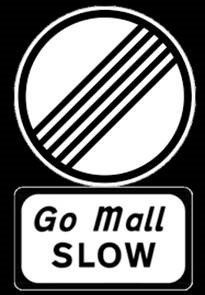
A rural speed limit sign.
Types of speed limits
There are different types of speed limits in Ireland:
- Urban speed limits (built-up areas)
- National road speed limits
- Regional and rural road speed limits
- Motorway speed limits
- Special speed limits
- Variable speed limits
Urban Speed Limits (50 km/h)
A speed limit of 50km/h is in place in built-up (urban) areas where there are no motorways or special speed limit zones. From late 2025, local authorities will begin to review speed limits in built-up and urban areas. This means built-up areas, housing estates and town centers. Speed limits will be reduced to 30km/h, where appropriate. The aim is to have these 30km/h limits in place by 31 March 2027. Local authorities will hold public consultations before any changes are made.
National road speed limits (100 km/h)
A default speed limit of 100 km/h is in place on national roads (including dual carriageways) in Ireland. This default speed limit may be varied (see special speed limits below). It is planned to reduce this to 80km/h on secondary roads. This change has not been introduced yet.
Regional and Rural Road Speed Limits
A default speed limit of 80 km/h is in place on regional roads. A default speed limit of 60 km/h is in place on local roads in rural settings.
This new speed limit for rural local roads came into effect on Friday 7 February 2025.
The rural speed limit sign (a white circle with five diagonal black lines with another plate that states “Go Mall / Slow”) means the speed limit is now 60 km/h.
Motorway speed limits (120 km/h)
A default speed limit of 120 km/h is in place on motorways. This default speed limit may be varied (see special speed limits below).
Learner drivers, vehicles under 50 cc, bicycles, pedestrians, animals are not allowed on motorways in Ireland.
Special speed limits
Special speed limits are sometimes applied to designated roads and zones (mainly, for example, on roads outside built-up areas, around schools). Special speed limits are generally 30 km/h or 60 km/h.
Local authorities in Ireland can introduce bye-laws to set special speed limits in designated areas. You can object to and appeal an existing special speed limit being set by a local authority.
You can get more information about speed limit bye-laws and appeals on speedlimits.ie. Read more about the powers of local authorities.
Variable speed limits (from 20 km/h up to 120 km/h)
Variable speed limits are in effect on specific roads in Ireland, including the M50.
Variable speed limits are electronically signed speed limits that can change as needed depending on conditions or other safety concerns.
Speed Limits for Buses, Trucks, and Towing Vehicles
Certain vehicles in Ireland must comply with lower speed limits than those on the road signs.
This applies mainly to:
- Vehicles that carry passengers
- Vehicles are greater than a certain weight
- Vehicles that are pulling trailers
| Vehicle Type |
Motorway/Dual Carriageway (km/h) |
Other Roads (km/h) |
| Buses (carrying standing passengers) | 65 | 65 |
| Coaches (seated passengers only) | 100 | 80 |
| Towing vehicles | 80 | 80 |
| Trucks (over 3,500kg) when drawing another vehicle | 90 (Motorway only) | 80 |
Emergency Vehicle Exceptions
Speed limits do not apply in Ireland to:
- Ambulances
- Fire brigade services
- Garda vehicles being used during duty
More information about speed limits is available in the Rules of the Road (pdf).
It is an offence for anyone to use a speed meter detector in any vehicle. Importing, fitting and supplying speed meter detectors and jammers is also an offence (Road Traffic (Speed Meter Detectors) Regulations, 1991).
The Gardai can seize this equipment if it is found in your vehicle or in your possession under the Customs Consolidation Act 1876 if the vehicle is on a public road.
Speed enforcement in Ireland
The Garda Síochána (Irish police force) enforces speed limits using:
- Fixed penalties
- Roadside checks
- Speed detection technology
Safety and average speed cameras
An Garda Síochána has contracted GoSafe to run speed cameras on their behalf.
The cameras operate from vans which are marked with high visibility reflective material and display a safety camera symbol.
Average speed detection is also used in Ireland. On certain roads in Ireland, the average speed you travel can be detected by average speed cameras. These cameras measure your average speed while driving between 2 points, unlike traditional speed cameras that only check your speed at one specific point along a road.
The average speed camera tracks how long it takes you to travel between 2 points and uses this information to calculate your average speed.
There are average speed cameras on the:
More information is available on garda.ie.
Fines and penalties for speeding
You can read the table to see fines, penalties and late payment for speeding offences.
| Action | Penalty |
| Exceeding speed limit | €160 fine + 3 penalty points |
| Late payment (after 28 days) | €240 fine |
| Failure to pay (after 56 days) |
€320 fine + 3 penalty points 7 days before court date Or on conviction up to €1,000 fine + 5 penalty points |
If you are not the driver of the vehicle, you must complete the relevant section on the notice and return it within 28 days of its issue.
More information
Further information on fixed-charge notices is available in our page on driving offences.