
Vaccinations for children and young people
- Introduction
- Where to get your child vaccinated in Ireland
- When to get your child vaccinated
- RSV vaccine for babies during winter
- MMR vaccine if you are going abroad or missed a dose
- If you or your child missed a vaccine
- More information
Introduction
Immunisation is a safe and effective way to help your body prevent or fight off certain diseases. You can get immunisation through vaccinations.
Check the table below to see what age you can get your child vaccinated.
How much do these vaccinations cost?
These vaccinations are free of charge.
Parental consent for vaccines
If you are under 16, you must get your parent or guardian's consent for vaccinations.
Vaccination is not compulsory but is strongly advised by the Department of Health. You should discuss any concerns you may have with your GP (family doctor) before making a decision about your child’s immunisation.
Where to get your child vaccinated in Ireland
You are usually offered your child's vaccinations by:
- The hospital where your baby was born
- The HSE
- Your GP (family doctor)
- The School Immunisation Programme or
- The HSE catch-up programme
You can also contact your Local Health Office or your GP directly.
Vaccines for babies
You will usually be offered vaccines for your baby from your GP until they are 13 months old, as part of the Primary Childhood Immunisation Schedule. You can also get your baby vaccinated in hospitals and health clinics.
You should make sure your baby gets their vaccinations on time, or as soon as possible after they are due. If your baby is due to have a routine vaccination, you should phone your GP to arrange it.
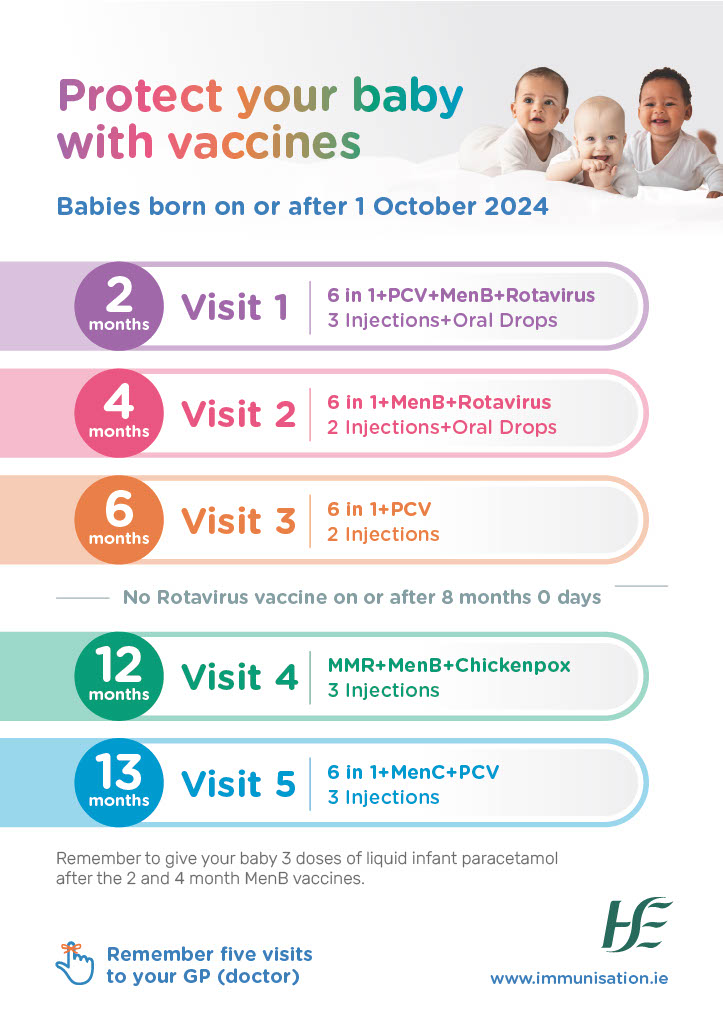
Read more information about vaccines available for your baby (pdf) and check the HSE vaccine schedule for children born on or after 1 October 2024 (pdf).
If you are travelling abroad with your baby, your GP can give your baby an MMR vaccine against measles, mumps and rubella if they are aged 6-11 months. Read more below.
Vaccines at school
When your child starts school, they can get more vaccinations under the School Immunisation Programme.
During winter, you can usually get the flu vaccine for your child if they are aged from 2 to 17. The flu vaccine for children is given by nasal spray rather than injection.
When to get your child vaccinated
| Age | Where | Vaccine |
| 2 days old | Hospital |
Respiratory syncytial virus (RSV) vaccine (For children born from September 2025 to 28 February 2026) |
| 2 months | GP |
1. 6 in1 (diphtheria, tetanus, whooping cough (pertussis), polio, Hib (Haemophilus Influenzae Type B) and Hepatitis B provided in one single injection) 2. PCV vaccines against pneumococcal disease 3. Meningococcal B vaccine 4. Oral vaccine to prevent rotavirus disease |
| 4 months | GP |
1. 6 in1 (diphtheria, tetanus, whooping cough (pertussis), polio, Hib (Haemophilus Influenzae Type B) and Hepatitis B provided in one single injection) 2. Meningococcal B vaccine 3. Oral vaccine to prevent rotavirus disease |
| 6 months | GP |
1. 6 in1 (diphtheria, tetanus, whooping cough (pertussis), polio, Hib (Haemophilus Influenzae Type B) and Hepatitis B provided in one single injection) 2. PCV vaccines against pneumococcal disease, |
| 12 months | GP | 1. MMR (measles, mumps and rubella) vaccine
2. Vaccine against Meningococcal B If born on or after 1 October 2024 your baby will also get: 3. Vaccine against chickenpox (varicella) |
| 13 months | GP |
1. Vaccine against Meningococcal C 2. PCV vaccine (protects against Pneumococcal Disease) If born after 1 October 2024 your baby will also get: 3. 6 in1 (diphtheria, tetanus, whooping cough (pertussis), polio, Hib (Haemophilus Influenzae Type B) and Hepatitis B provided in one single injection) |
|
2-17 years |
GP or pharmacy |
|
| 4–5 years | GP or school |
1. 4 in 1 (diphtheria, tetanus, whooping cough (pertussis) and polio) 2. MMR (measles, mumps and rubella) vaccine (second dose) If born on or after 1 October 2024 your baby will also get: 3. Vaccine against chickenpox (second dose of varicella) |
| 11–14 years
1st year in second-level schools |
School |
1. Tdap (tetanus and low-dose diphtheria) booster 3. HPV (Human Papillomavirus Virus) vaccine (3 doses) |
RSV vaccine for babies during winter
Respiratory syncytial virus (RSV) causes respiratory infection in children and adults. The infection can be severe in the youngest babies, especially those born during the Autumn and Winter months.
From 1 September 2025 to 28 February 2026, you will be offered an RSV vaccine for your baby at the hospital if they are:
- Born during these dates
- Born prematurely during these dates
- Born with underlying medical conditions during these dates
If your baby was born between 1 March 2025 and 31 August 2025, you can now book an RSV vaccine appointment online. Appointments for this age group will be available in September and early October 2025.
MMR vaccine if you are going abroad or missed a dose
Your child will usually be offered the MMR (measles, mumps and rubella) vaccine when they are 12 months old, followed by a second dose when they are aged 4-5 years old in junior infants.
Your GP can give a free MMR vaccination:
- If your child missed a dose of their MMR vaccine
- If you are aged 18 to 46 and have not had 2 doses of the MMR vaccine
If you cannot find your vaccination records, it will not harm you to have the MMR vaccine again.
Certain people should make sure to get the MMR vaccine.
You can read about when to delay getting the MMR vaccine and who should not get it, as well as information on how the MMR vaccine works and possible side effects.
Adults born in Ireland before 1978 are likely to have had measles infection and so would not need to get the MMR vaccination.
Getting an early MMR vaccination for your baby before travelling
If you are travelling abroad with your baby, your GP can give them a dose of the MMR vaccine if they are aged 6-11 months. It is best to get the MMR vaccine for your baby 2 weeks before you travel.
If your baby is under 6 months, they cannot get the MMR vaccine. They still have any protection that was passed on during pregnancy.
If your child gets the MMR vaccine before they are 12 months, they still need to get the regular vaccine schedule at age 12 months and at 4 to 5 years in junior infants (see table above).
If you or any other children have not had 2 doses of the MMR vaccine, you can also get it free from your GP (see above). It is important to plan your travel abroad as some countries are experiencing an outbreak of measles and have regular cases.
If you or your child missed a vaccine
If you or your child missed certain vaccines when they were offered, the HSE can sometimes provide these vaccines later in life. Vaccine catch-up programmes are often only available to certain age groups and during a specific time period.
If your child missed a dose, ask your GP for a catch-up vaccine appointment.
Read more about getting an MMR vaccine for you or your children above.
HPV catch-up programme
The HPV catch-up programme ended on 31 December 2023.
More information
You can get information about all immunisations from your GP, public health nurse or Local Health Office.
The HSE's National Immunisation Office website and the Health Protection Surveillance Centre (HPSC) have produced useful facts on immunisations for parents in different languages.